




















Fashion brands selling into Europe are moving toward a market where product information will need to be more structured, traceable and accessible throughout a garment’s lifecycle.
A major part of that shift is the Digital Product Passport for textiles.
Under the EU’s Ecodesign for Sustainable Products Regulation (ESPR), Digital Product Passports are being developed as digital records that can connect physical products with relevant information about their identity, materials, supply chain and circularity. Textile apparel is already listed among the priority product groups in the ESPR Working Plan 2025–2030.
For fashion brands, however, the important message is not that every garment needs a completed passport immediately.
Textile-specific requirements are still being developed. The European Commission currently indicates a planned adoption of the textile ESPR delegated act in Q4 2027, and the exact information requirements may evolve before then.
The sensible approach is therefore to start building better product and supplier data now.
What Is a Digital Product Passport for Textiles?
A Digital Product Passport, or DPP, is a structured digital record connected to a physical product.
For textiles, it is expected to make selected product information available throughout different stages of a garment’s lifecycle—from manufacturing and sale to repair, reuse and recycling.
The European Commission describes the DPP as a way to improve transparency across textile value chains and make relevant product information more accessible and comparable.
A garment may eventually be connected to its passport through a data carrier such as a QR code, while information can also be accessible at online points of sale.
Rather than thinking of the passport as another label, brands should think of it as a structured product-data system.

Why Are Textiles a Priority?
Textiles have been specifically identified by the EU as an important product category within its transition toward more sustainable and circular products.
The EU Strategy for Sustainable and Circular Textiles includes Digital Product Passports alongside measures designed to improve durability, repairability, recyclability and the availability of reliable product information.
For brands, this means sustainability claims will increasingly need to be supported by organized data.
Knowing that a hoodie contains cotton and polyester may no longer be enough from a data-management perspective.
A brand may need to understand:
- exactly which materials were used;
- who supplied them;
- where relevant manufacturing stages took place;
- which product or batch the information relates to;
- what documentation supports the information;
- how the product should be maintained, repaired or recycled.
The final textile-specific DPP requirements have not yet been fixed, but these are the types of information businesses should begin organizing.
What Information Could a Textile DPP Contain?
The European Commission currently identifies several possible categories of textile passport information, while stressing that the exact requirements will be defined through future delegated acts.
Product Identification
Every product needs a reliable identity before meaningful traceability is possible.
Brands should already maintain structured information such as:
Style code → product name → color → size range → production order → production batch
That connection matters because documentation becomes much less useful when it cannot be linked back to a specific product.
Material and Fibre Composition
Material composition is likely to become one of the most important data areas.
Brands should be able to distinguish between the main fabric, rib, lining, interlining, sewing thread, labels and other relevant components.
Instead of recording only:
100% cotton hoodie
a stronger internal data record could include the fabric reference, composition, GSM, supplier, color, production lot and supporting documentation.
The Commission specifically identifies fibre composition as one category that may be relevant to textile DPP requirements.
Supply-Chain and Economic Operator Information
A garment can involve several parties before reaching the customer.
Depending on the product, these may include:
fabric mills, dye houses, trim suppliers, printers, embroidery facilities, cut-and-sew manufacturers and the brand itself.
Future DPP requirements may include origin information and identification of relevant economic operators.
Brands should therefore begin mapping which supplier is responsible for each major component and production stage.
Traceability Starts Before Bulk Production
Traceability is difficult to create retrospectively.
If supplier information, fabric references and production records are lost after an order is completed, rebuilding the chain later can become expensive and unreliable.
A better system begins during product development.

For example, when approving a fabric for bulk production, the brand and manufacturer can connect the approved material to:
- the tech pack;
- fabric supplier reference;
- fibre composition;
- GSM or relevant specification;
- color reference;
- test reports where applicable;
- production order;
- finished style.
This creates a documentation trail that can eventually feed into a Digital Product Passport system.
Durability, Repair and Circularity Data
The DPP is also connected to Europe’s broader circular-product strategy.
The Commission indicates that textile passports may contain information supporting use, repair and maintenance, as well as reuse, resale, disassembly, refurbishment, disposal and recycling.
That could affect product development decisions long before a QR code is added to a garment.
Brands may increasingly need to understand questions such as:
Can a damaged component be replaced?
Are blended materials difficult to recycle?
What care instructions help preserve garment life?
Can trims be separated from the main textile?
These questions turn circularity from a marketing concept into a product-development consideration.
Supplier Documentation Will Become More Valuable
Fashion brands cannot create reliable product passports using brand-side information alone.
Much of the underlying information originates with manufacturers and upstream suppliers.
Fabric specifications, production references, certificates, test reports and supplier declarations may all contribute to a stronger product record.
This makes manufacturer selection increasingly important.
A supplier that can manufacture a good garment but cannot organize product information may create additional work for brands operating in markets with growing traceability requirements.
How Fashion Brands Can Prepare Today
Brands do not need to wait for every textile DPP field to be finalized before improving their systems.
Start by creating a standardized product-data structure covering:
Product → Materials → Suppliers → Manufacturing → Documentation → Batch → Finished Goods
Then audit existing collections.
Identify where data is missing, inconsistent or stored only in emails and spreadsheets that cannot easily be connected.
The goal is not to predict every future regulatory requirement. It is to create a reliable information foundation that can adapt once the final textile rules are published.
That distinction is important because the European Commission’s textile-specific DPP requirements are still under development.
The DPP Infrastructure Is Already Becoming Operational
The wider European DPP framework is progressing even while textile-specific requirements are being developed.
On 20 July 2026, the European Commission launched the Digital Product Passport Registry together with a testing environment.
The Registry is designed to register unique product identifiers and associated metadata, while the underlying product data remains decentralized. Businesses can interact with the Registry through a user interface or API.
This development is another reason brands should treat structured product data as an operational issue rather than a distant sustainability project.
Why Manufacturer-Brand Collaboration Matters

Preparing for the Digital Product Passport for textiles will require closer coordination between brands and manufacturing partners.
The brand controls product strategy, compliance decisions and market placement.
The manufacturer often sits closer to the practical information: fabrics, trims, sampling, production batches, printing, embroidery and quality-control records.
When both sides establish documentation requirements before production begins, collecting reliable data becomes considerably easier.
For brands sourcing in Turkey, working with an integrated manufacturing partner can help reduce the number of disconnected information points across sourcing, development and production.
Preparing Your Supply Chain with Istanbul Factory
At Istanbul Factory, we work with fashion brands, streetwear labels, startups and established companies that need more than garment assembly.
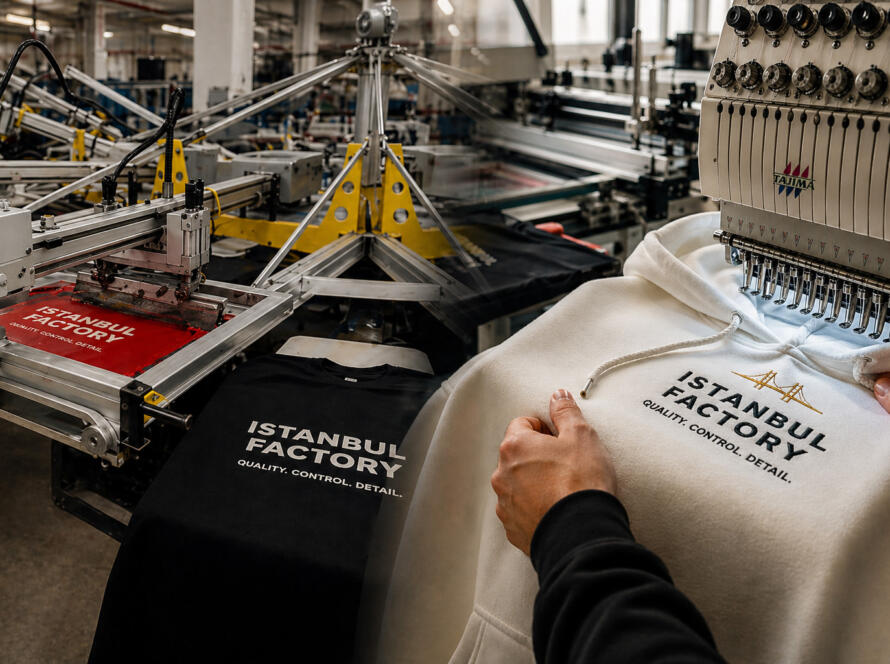
Our production approach can bring together fabric sourcing, sampling, custom clothing manufacturing, private label development, print and embroidery, production and quality control within a coordinated workflow.
As product traceability becomes more important, brands should discuss documentation requirements with their manufacturing partner at the beginning of development—not after bulk production has finished.
If your brand is preparing future collections for the European market, contact Istanbul Factory to discuss your product, sourcing and manufacturing requirements.
Frequently Asked Questions
What is a Digital Product Passport for textiles?
A Digital Product Passport is a digital record connected to a textile product that can provide structured information about the product, its materials, relevant economic operators and potentially its use, repair and end-of-life characteristics.
Are Digital Product Passports already mandatory for clothing?
The ESPR establishes the DPP framework, and textile apparel is a priority product group. However, textile-specific requirements are still being developed. The European Commission currently plans adoption of the textile delegated act for Q4 2027, although the timeline may change.
What data should fashion brands start collecting?
Brands can begin organizing product identifiers, material compositions, supplier references, manufacturing information, certificates, test documents, batch records and care or circularity information.
Will garments have QR codes?
The European Commission states that textile DPP information will be accessible through a data carrier on the product, such as a QR code, as well as at online points of sale. Exact implementation requirements will depend on the final rules.
Why should brands prepare before the rules are final?
Building traceability after production is much harder than capturing information during sourcing and manufacturing. Creating structured supplier and product records now can make future DPP implementation more manageable.